

Greetings to new readers and welcome all to the latest edition of the weekly ASEAN Wonk BulletBrief! If you haven’t already, you can upgrade to a paid subscription for $5 a month/$50 a year below to receive full posts by inserting your email address and then selecting an annual or monthly option. You can visit this page for more on pricing for institutions, groups as well as discounts. For current paid subscribers, please make sure you’re hitting the “view entire message” prompt if it comes up at the end of a post to see the full version.
For this iteration of ASEAN Wonk BulletBrief, we are looking at:
Assessing geopolitical and geoeconomic significance of Davos 2026-related developments and implications for Southeast Asia and the Indo-Pacific;
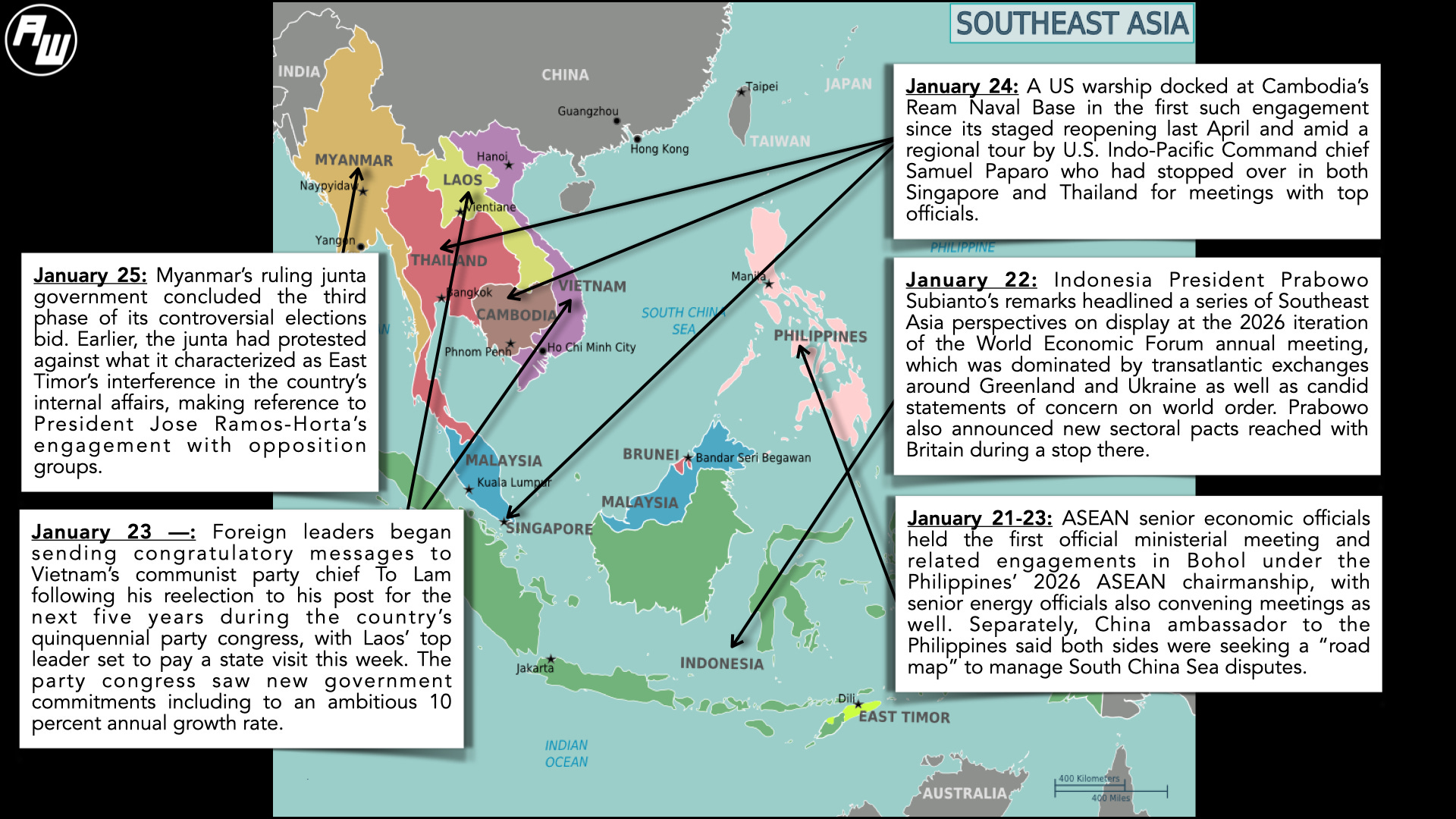
Mapping of regional developments, such as new Ream naval base warship docking; flashpoint roadmap chatter and more;
Charting evolving geopolitical, geoeconomic and security trends such as first artificial intelligence framework; new rare earths update; and port expansion;
Tracking and analysis of industry developments and quantitative indicators including new energy patrol; looming megaproject and big rail upgrade talk;
And much more! ICYMI, check out our ASEAN Wonk review earlier this week of a new book on potential futures in a “Second Eurasian Century.”
This Week’s WonkCount: 2,227 words (~10 minutes)


New Warship Docking; Flashpoint Roadmap & More

Navigating Patchwork Dynamics; Pivot Fulcrum & Flashpoint Stakes
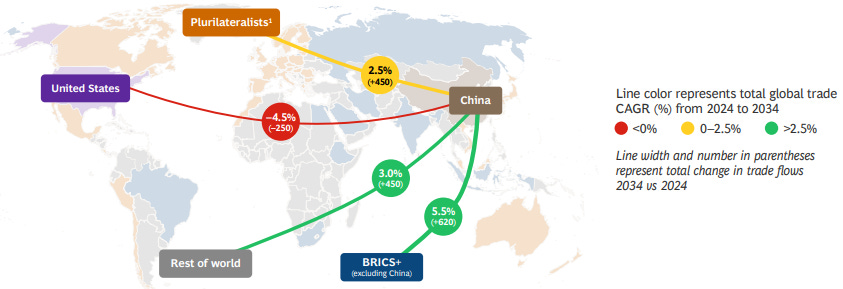
“As multilateralism dissolves, a new order seems to be emerging in which goods are traded under different sets of rules,” argues a new report by the Boston Consulting Group. The report lays out a patchwork scenario where trade would be managed through four main nodes — plurilateralist nations; “BRICS+” countries; China and the United States (link).
2034 vs. 2024 Forecasted Estimated Change in Trade of Goods (in US$ billions)
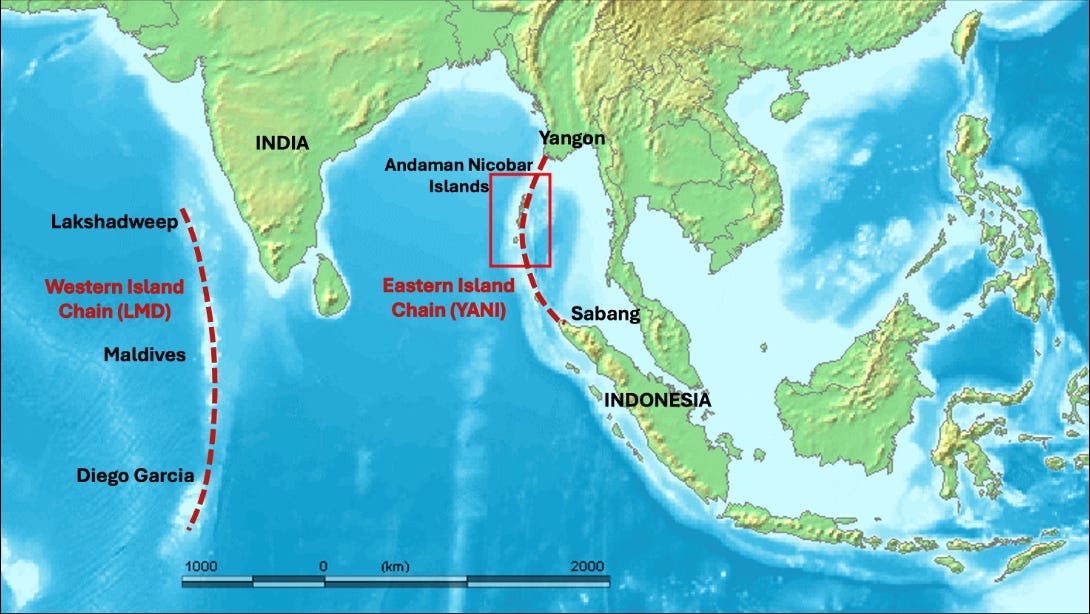
“Andaman and Nicobar Islands are poised to serve as India’s strategic gateway to Southeast Asia,” according to a new report published by a serving chief in the Indian Defense Forces via Observer Research Foundation. The piece makes the case for the islands as moving from a “remote outpost to a central player in India’s Act East policy and regional maritime affairs,” with realizing this potential being “not optional but essential for India’s regional standing” (link).
Depiction of Eastern and Western Island Chain in Indian Ocean Region
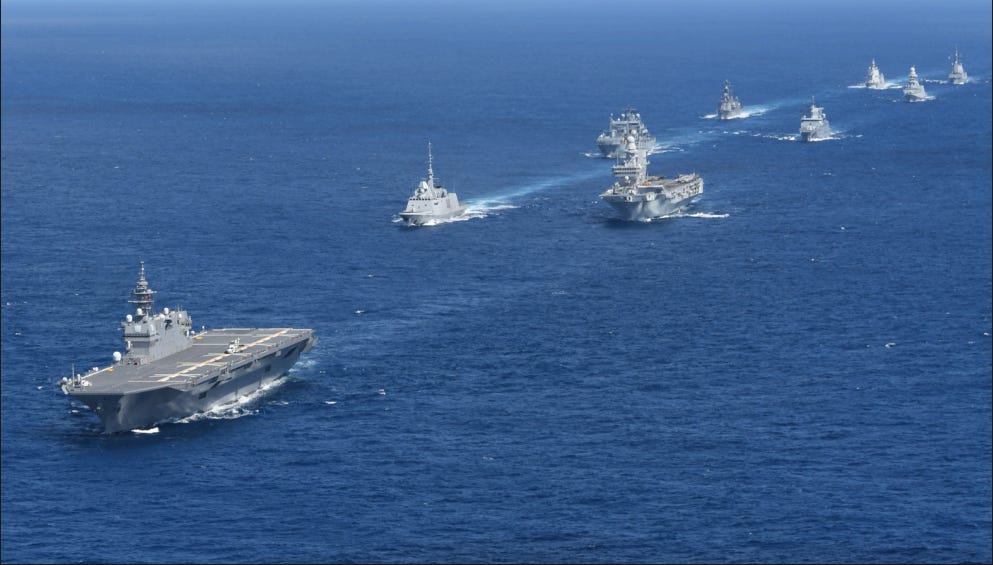
“There needs to be continued and expanded naval presence by external middle-power countries,” concludes a new edited volume on external stakeholders in the South China Sea published by the Asia-Pacific Leadership Network. Other focus areas highlighted include capacity-building, maritime domain awareness and confidence-building measures (link).

Davos 2026 ASEAN Lens and Prabowo Indonesia Geoeconomic Push
What’s Behind It
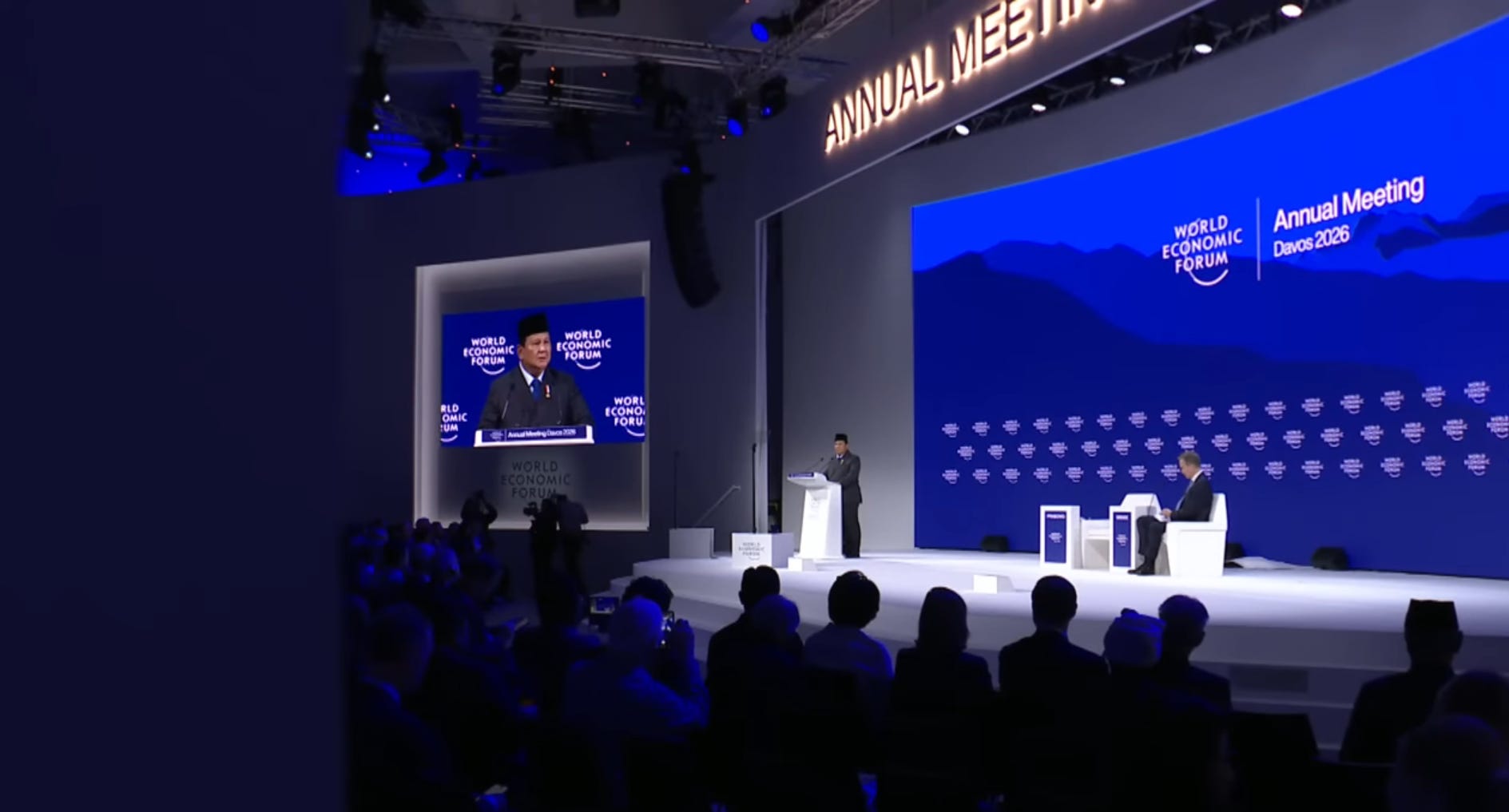
Southeast Asia was in the spotlight during this iteration of the World Economic Forum annual meeting in Davos amid wider geopolitical developments, headlined by Indonesia President Prabowo Subianto’s geoeconomic pitch1. One official familiar with the participant dynamics noted that Indonesia had to “manage carefully” the optics that the country was the only one of eleven countries in Southeast Asia that was a headline participant in U.S. President Donald Trump’s Board of Peace Charter signing at Davos, even though others had also been at the signing ceremony or publicized statements of consideration following invitations that were sent2. Meanwhile, Thailand warned that inaction on Southeast Asia’s scam crisis risked turning the regional challenge into something analogous to Latin America’s drug cartels, with criminal networks not just challenging but “being part of state authorities,” just weeks after the country had hosted an international conference on the issue.3
Select Key Recent Regional Geopolitical and Geoeconomic Developments Related to 2026 World Economic Forum Annual Meetings
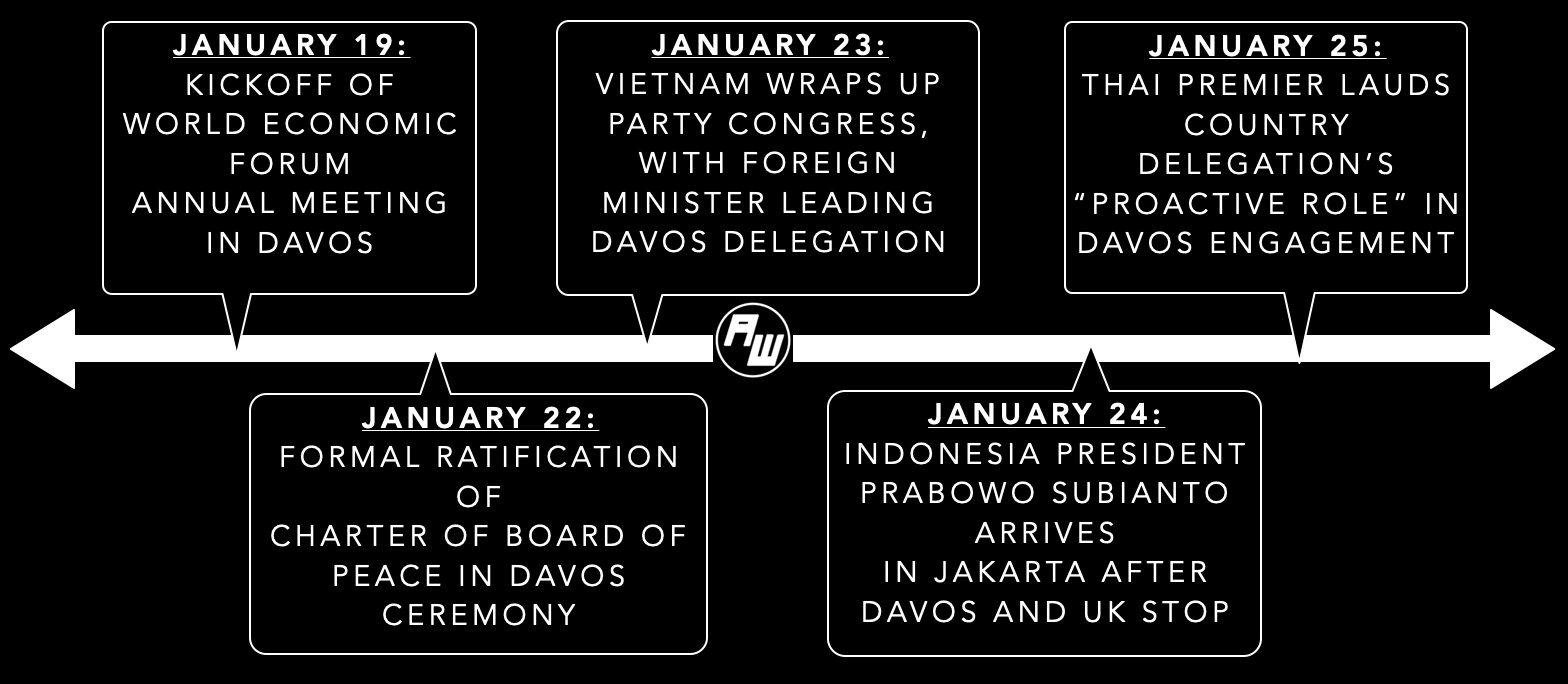
The spotlight came amid other significant developments on the sidelines of Davos that received relatively less attention than they warranted amid headlines dominated by transatlantic exchanges around Greenland and Ukraine as well as candid statements of concern around world order as we noted on ASEAN Wonk earlier this week. This included the launch of a “first-of-its-kind” artificial intelligence governance framework model from Southeast Asia as well as the kicking off of a new advisory group to remove bottlenecks impeding the supercharging and scaling of investment into Asia4. While Vietnam was busy wrapping up its quinquennial party congress at home, the country still managed to field a high-level delegation at Davos relative to other Southeast Asian states, with officials noting the opportunity to engage on a number of fronts including ongoing economic talks with the United States5.
Why It Matters
The perspectives on display also spotlighted datapoints to watch with wider implications (see originally generated ASEAN Wonk table below on notable areas to monitor and additional specifics. Paying subscribers can read on for more on what to expect and future implications in the rest of the “Why It Matters” and “Where It’s Headed” sections, along with paid-only sections of the newsletter as usual).
Notable New Datapoints to Watch, Alongside Key Policy Stakeholders and Major Countries
