

Greetings to new readers and welcome all to the latest edition of the weekly ASEAN Wonk BulletBrief! If you haven’t already, you can upgrade to a paid subscription for $5 a month/$50 a year below to receive full posts by inserting your email address and then selecting an annual or monthly option. You can visit this page for more on pricing for institutions, groups as well as discounts. For current paid subscribers, please make sure you’re hitting the “view entire message” prompt if it comes up at the end of a post to see the full version.
For this iteration of ASEAN Wonk BulletBrief, we are looking at:
Assessing the geopolitical and geoeconomic significance of coming U.S. defense policy in Southeast Asia and implications for the wider region beyond a recent U.S.-ASEAN maritime exercise;
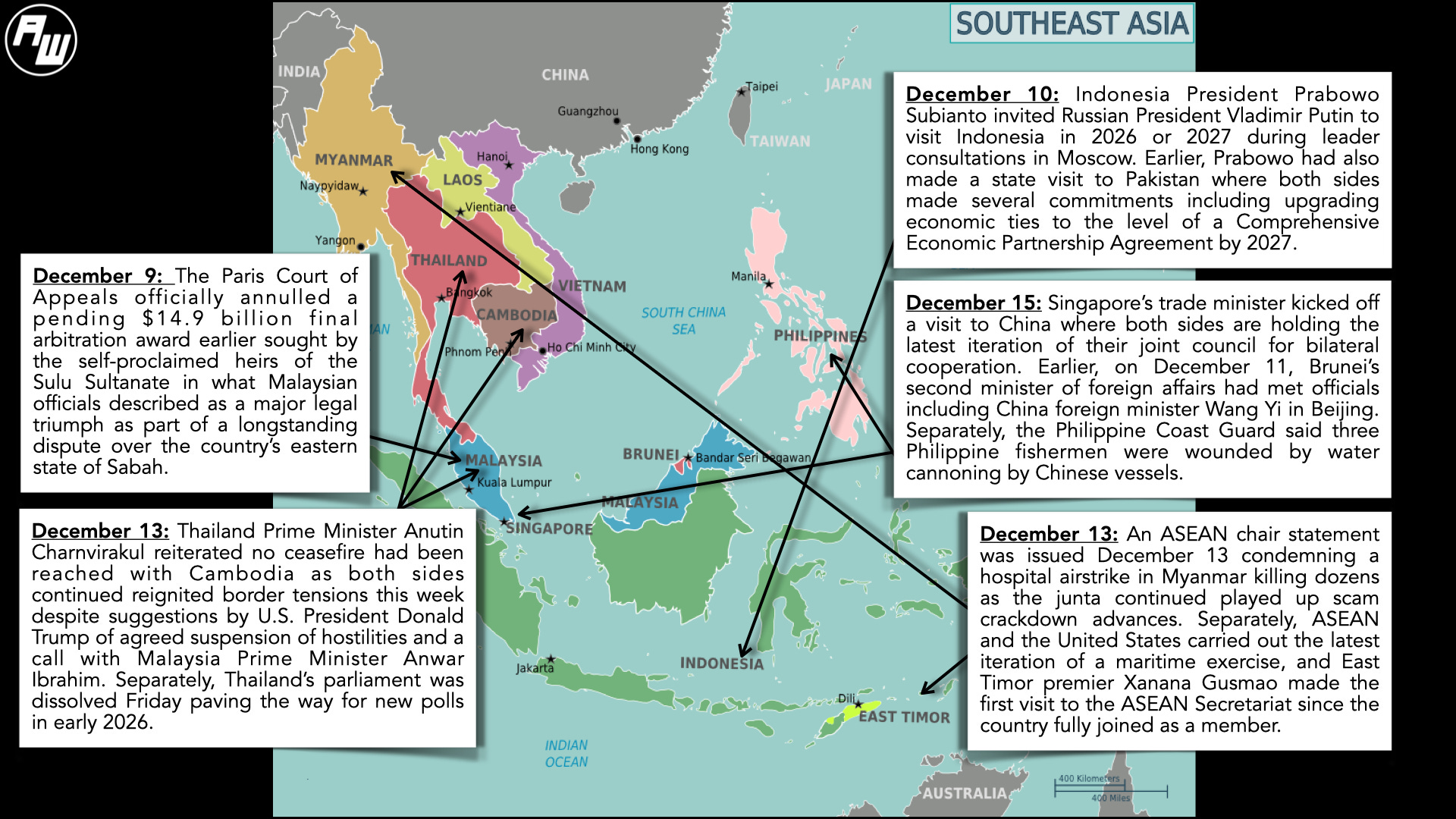
Mapping of regional developments, such as regional airstrike condemnation and evolving Kremlin summitry dynamics;
Charting evolving geopolitical, geoeconomic and security trends such as new rare earths ban; minilateral admission inroads and quiet foreign investment disclosure;
Tracking and analysis of industry developments and quantitative indicators including port strategic plan; coming fighter jet delivery; new trade pact tracker and more;
And much more! ICYMI, check out our ASEAN Wonk review of a new book on Asia’s geopolitical futures and India’s strategic role.
This Week’s WonkCount: 2,146 words (~10 minutes)


Airstrike Condemnation; Kremlin Summitry & More

Critical Minerals Futures; Coming Crisis & Separation Declassification
“Export restrictions could trigger a supply crisis,” warns a newly-released report by the Economic Research Institute for ASEAN and East Asia (ERIA) on risks and opportunities for the critical mineral supply chain in Southeast Asia. The study assesses the potential for collaboration across six battery-relevant minerals across upstream, downstream and midstream supply chain segments — lithium, nickel, cobalt, manganese, copper as well as graphite (link).
Map Depicting ASEAN Critical Mineral Production By Country And Percentage Of Global Production

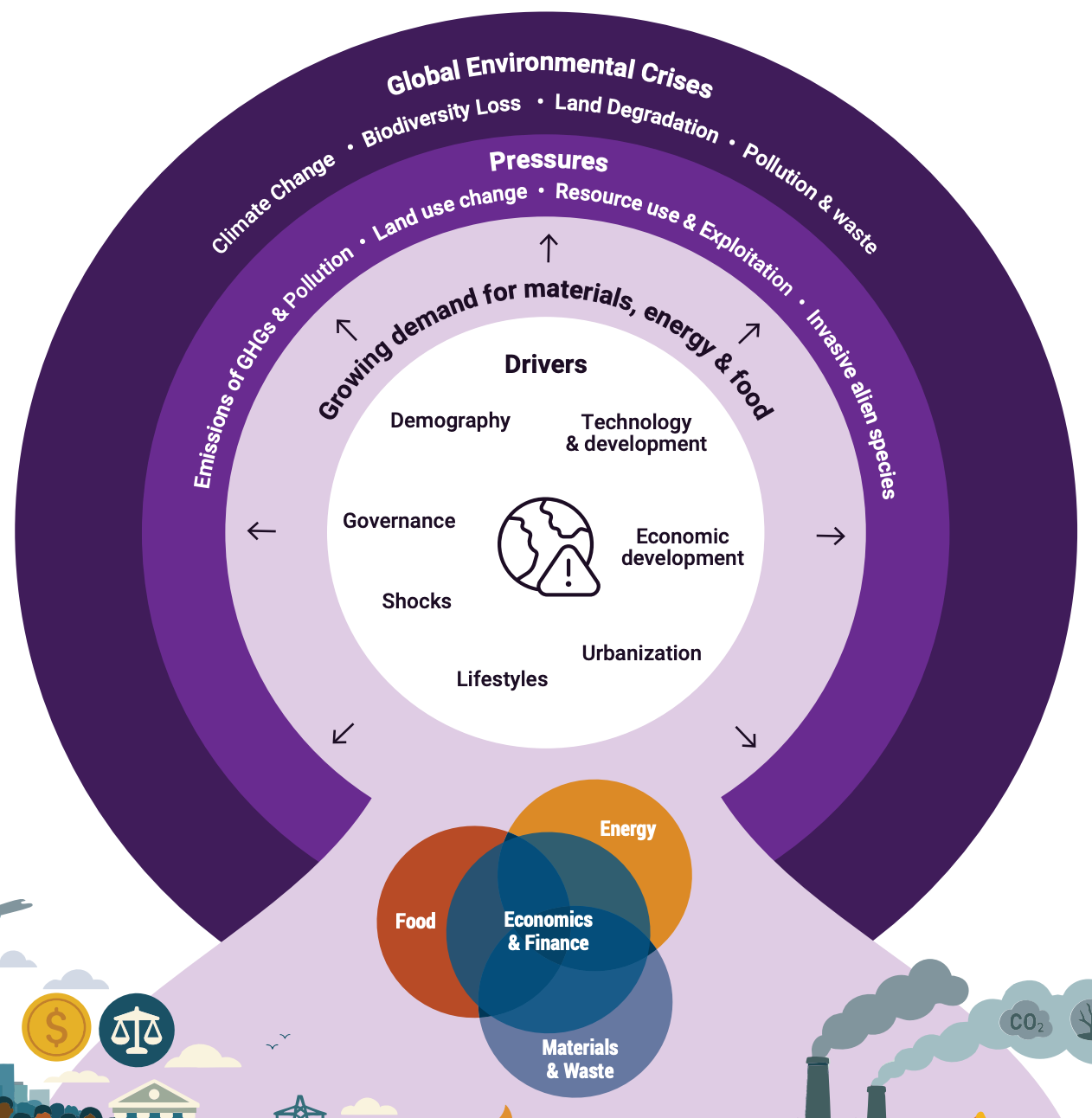
Global decisionmakers need a systematic approach,” notes an outlook released by the United Nations on a comprehensive assessment of the interconnectivities inherent in the global environmental crisis. The assessment notes that some burdens in areas like health remain high in subregions like Southeast Asia, and outlines scenarios beyond business as usual that involve changes in both technology as well as human behavior (link).
Graphic Depicting Components Of Global Environmental Crises
“The key question concerning Separation is this: “Was Singapore kicked out by Malaysia, or did we seek Separation?…Such an earth-shaking – and at that time, unexpected – outcome could not have had a simple or singular cause,” writes former prime minister Lee Hsien Loong on his decision to declassify the so-called “Albatross File” which was recently accompanied by a book release and exhibition in Singapore (link).


New Maritime Exercise Spotlights ASEAN US Security Futures
What’s Behind It
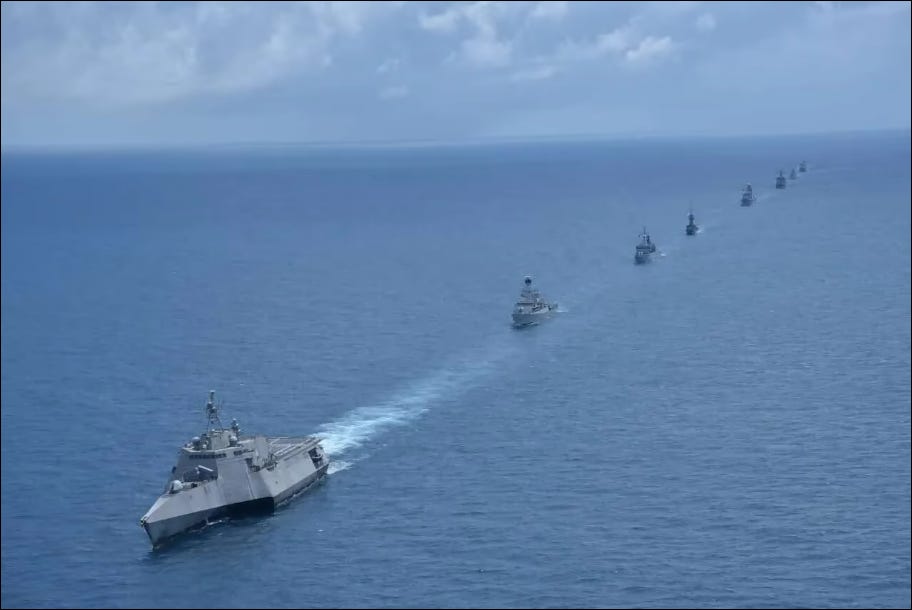
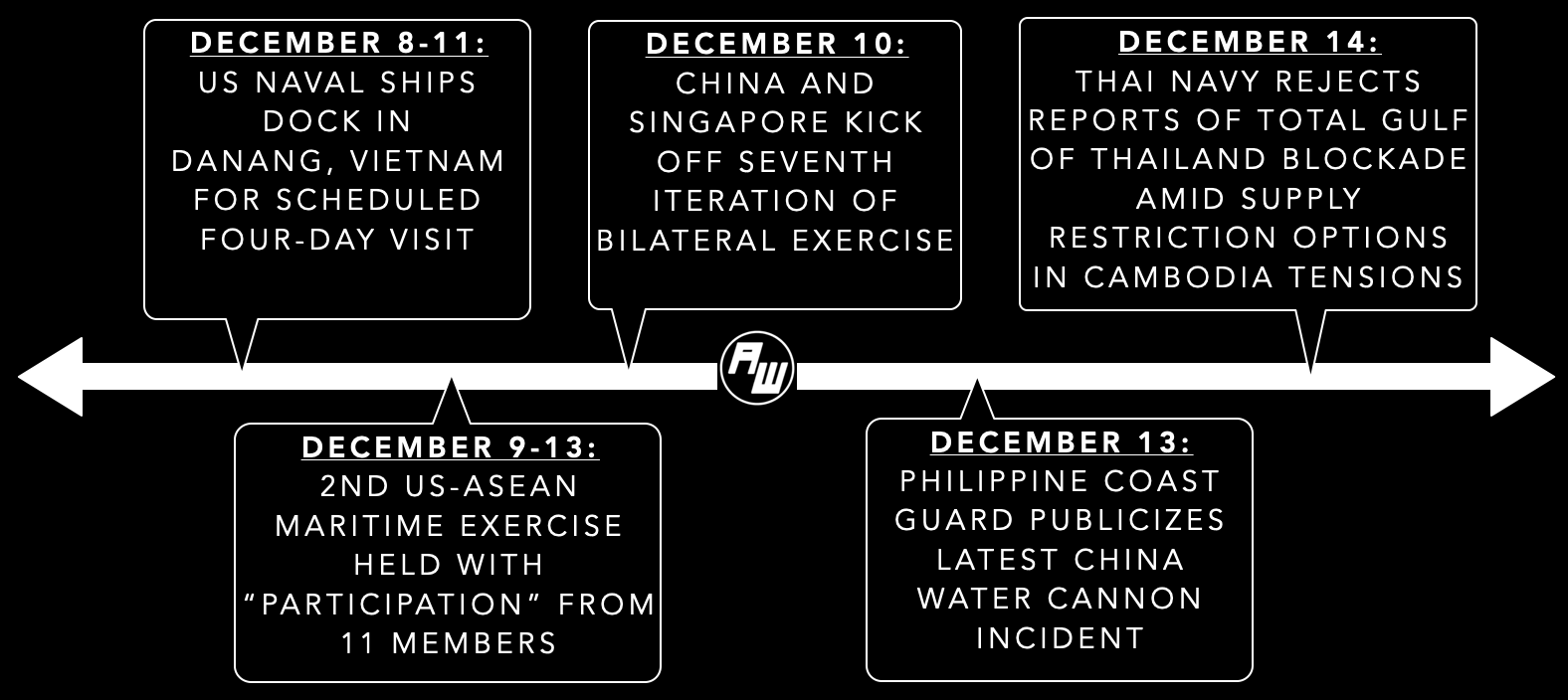
This past week witnessed the holding of the second iteration of the scheduled U.S.-ASEAN Maritime Exercise (AUMX) between Washington and Southeast Asian states1. The exercise was held alongside other defense-related developments over the past week — including a China-Singapore exercise and responses by the Thai navy to speculation surrounding a Gulf of Thailand blockade in Cambodia tensions — amid what some have characterized is a U.S.-Southeast Asia security agenda with much more work to be done2. For instance, one senior official disclosed in a closely tracked conversation by security watchers that partnerships with Southeast Asian states needed to urgently address ground realities, including China buying up strategic land and other assets close to U.S. military facilities as part of a multipronged effort to incrementally drive Washington out of the region3.
Select Key Recent Security-Related Developments Involving Southeast Asian States
The exercise was the latest datapoint in the new U.S. administration’s evolving approach to Southeast Asia including in the security realm. The headlines so far have focused on countries that have seen defense-related inroads already in the works as they have been what one Southeast Asian official characterized as “risky first in line entrants” into aspects of the Trump administration’s geoeconomic-focused agenda on issues like tariffs, with cases in point including Cambodia and Malaysia. Yet greater uncertainty surrounds some other partners in a dynamic geopolitical and geoeconomic environment. For instance, even officials from Indonesia (which co-chaired AUMX) have been more focused on navigating trade deal complexities with the second Trump administration — which some privately note was initially made even more difficult by Malaysia reaching early agreement4.
Why It Matters
The dynamics also spotlighted datapoints to watch with wider implications (see originally generated ASEAN Wonk table below on notable areas to monitor and additional specifics. Paying subscribers can read on for more on what to expect and future implications in the rest of the “Why It Matters” and “Where It’s Headed” sections, along with paid-only sections of the newsletter as usual).
Future Policy Datapoints to Watch in US Defense Policy, Including New Lines of Effort and Major Areas
