

Mandalas of Multialignment: Southeast Asia’s Hedging Bets
Background
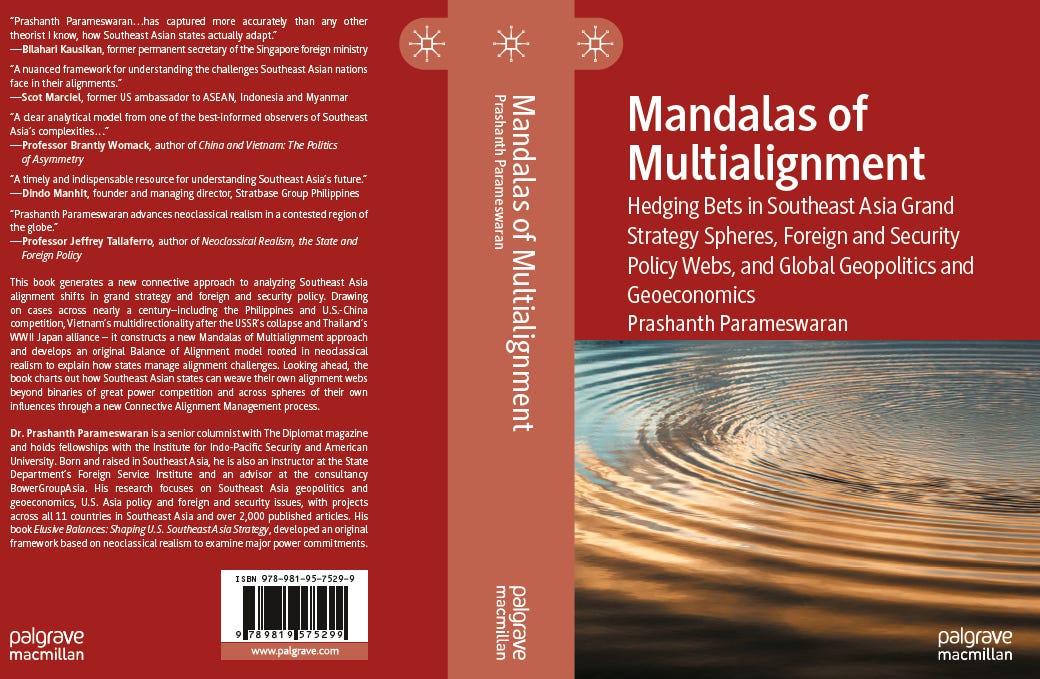
We’re briefly breaking from our regular schedule which will continue later this week as usual to announce the publication of a new book Mandalas of Multialignment: Hedging Bets in Southeast Asia Grand Strategy Spheres, Foreign and Security Policy Webs, and Global Geopolitics and Geoeconomics. The book articulates a new and connective balance of alignment model to explain and forecast shifts in grand strategy and foreign and security policy derived from an approach known as neoclassical realism; regional cases over nearly a century; and hundreds of conversations with policymakers across all 11 countries in Southeast Asia.
Some early kind words on the book from practitioners and scholars:
“Prashanth Parameswaran…has captured more accurately than any other theorist I know, how Southeast Asian states actually adapt”
– Bilahari Kausikan, former permanent secretary of the Singapore foreign ministry
“A nuanced framework for understanding the challenges Southeast Asian nations face in their alignments”
– Scot Marciel, former US ambassador to ASEAN, Indonesia and Myanmar
“A clear analytical model from one of the best-informed observers of Southeast Asia’s complexities…”
– Professor Brantly Womack, author, China and Vietnam: The Politics of Asymmetry
“A timely and indispensable resource for understanding Southeast Asia’s future”
– Dindo Manhit, founder and managing director, Stratbase Group Philippines
“Prashanth Parameswaran advances neoclassical realism in a contested region”
– Professor Jeffrey Taliaferro, author, Neoclassical Realism, the State and Foreign Policy
Before offering a snapshot of what the book details below, first and foremost our sincere thanks to the ASEAN Wonk community for the support over the years! As readers will note, the book draws on insights shared here including podcast dialogues, book reviews and conversations with regional policymakers across Southeast Asia along with key Indo-Pacific capitals.

Significance
The book argues that given Southeast Asia’s diverse and evolving historical experience with tighter and looser alignments that transcend more rigid versions of any one single approach – be it non-alignment, balancing, bandwagoning or hedging – forecasting how Southeast Asian states will seek to exercise agency in the future requires a connective “inside-out” perspective on the full breadth of alignments going back decades, rather than an “outside-in” perspective of how they think about one or two powers at a single point. This reframing of alignment shifts the focus from how countries navigate major power competition to how countries shape grand strategy spheres and weave alignment webs within their own “North Stars” in geopolitics and geoeconomics. As Malaysia Prime Minister Anwar Ibrahim put it at the last Shangri-La Dialogue in Singapore as ASEAN chair, Southeast Asia’s status as a “crossroads” — from ancient trade routes of the past to data centers of the present — is contingent upon the preservation of an ability “to act on our own terms.”1
Yet as the book notes, the ability to act on one’s own terms today and tomorrow is a contested one as it has been through much of the region’s history. The majority of Southeast Asia’s 11 countries have learned the risks of previously pursued tighter alignments relative to the looser ones that dominate the region today including strategic partnerships, with cases in point such as Vietnam’s tighter alignment with the Soviet Union reoriented after the latter’s demise or the Philippines under President Rodrigo Duterte’s (ultimately failed) U.S.-China shift bid. And even in the days of precolonial Southeast Asia, intraregional conceptions such as “mandalas” that frame the book — a Sanskrit term that can be used to represent a looser governance model with power radiating from the center through concentric circles – are important reminders that alignments need to be carefully calibrated even among neighbors. Six decades ago, Singapore’s founding premier Lee Kuan Yew captured the connectivity between alignments succinctly when he said amid Britain’s withdrawal from Southeast Asia that “the stage is set for local big fish to settle terms with small fish and small fish with shrimps.”2 More recently, Vietnam’s communist party chief To Lam noted recently on the wider risks from intensifying geopolitical competition and global disorder, given that “pressures to take sides…have reemerged in more sophisticated forms” including in geoeconomic areas such as strategic supply chains, technological standards and critical minerals, the question of autonomy for countries like Vietnam who fiercely won their independence “is a matter of life and death.”3
The approach suggests three insights relevant for shifting policy dynamics…