

Greetings to new readers and welcome all to the latest edition of the weekly ASEAN Wonk BulletBrief! If you haven’t already, you can upgrade to a paid subscription for $5 a month/$50 a year below to receive full posts by inserting your email address and then selecting an annual or monthly option. You can visit this page for more on pricing for institutions, groups as well as discounts. For current paid subscribers, please make sure you’re hitting the “view entire message” prompt if it comes up at the end of a post to see the full version.
For this iteration of ASEAN Wonk BulletBrief, we are looking at:
Assessing the geopolitical and geoeconomic significance of big major power digital stakes after a kickoff round of key 2026 regional meetings;
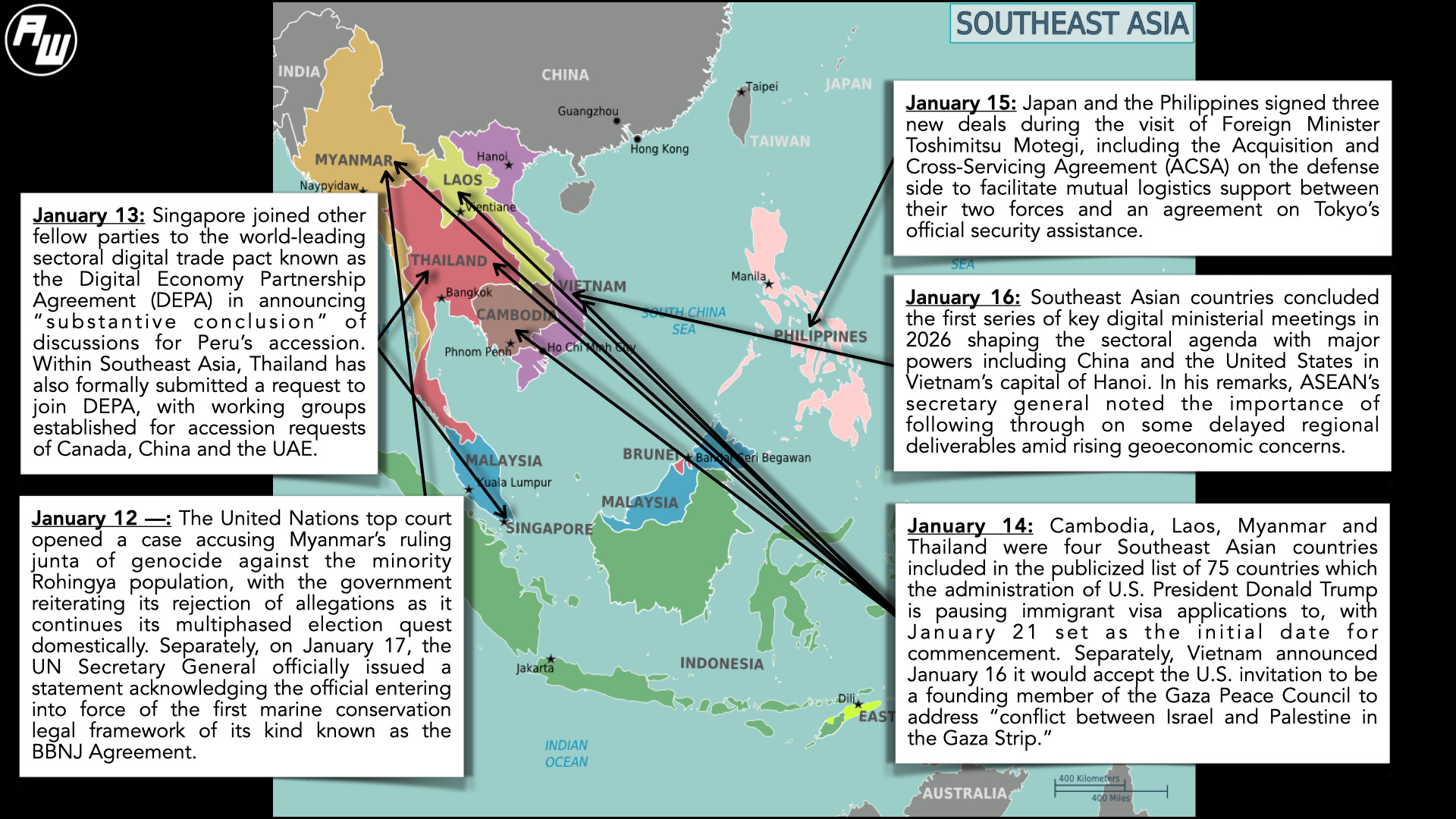
Mapping of regional developments, such as new sectoral trade agreement expansion and maritime pact entering into force;
Charting evolving geopolitical, geoeconomic and security trends such as new quiet China defense deal; groundbreaking semiconductor inroads and sectoral trilateral advance;
Tracking and analysis of industry developments and quantitative indicators including finalized cross-continental agreement; Indo-Pacific connectivity initiative and new infrastructure push pledge;
And much more! ICYMI, check out our ASEAN Wonk review of a new book by an ex-military chief on a new strategy to defend Taiwan from China.
This Week’s WonkCount: 2,247 words (~10 minutes)


New Sectoral Trade Agreement Expansion; Maritime Pact Enters Into Force & More

Shifting Security Scenarios; Regional Conflict Management Strategies & Agency in Practice Beyond US-China Competition
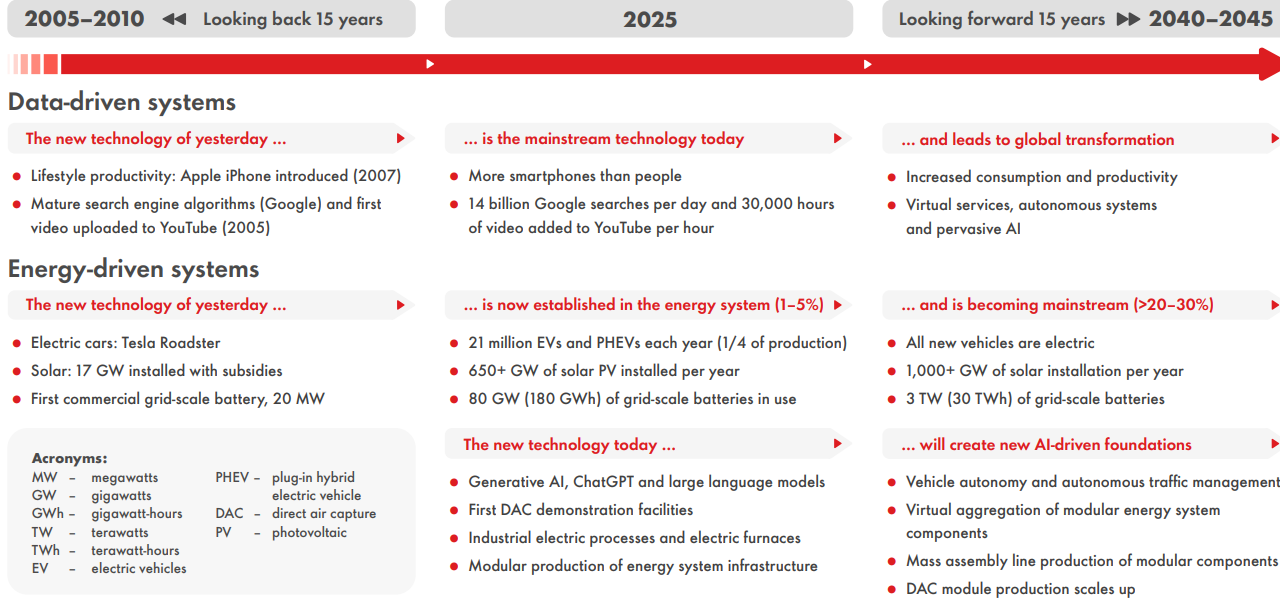
“As 2026 unfolds, new threats, including some led by AI concerns, unresolved conflicts and heightened trade tensions have put the world on edge…these developments require a rethink of both how global growth might develop and how the energy transition could unfold,” argues a new report published by Shell updating its set of future scenarios. The three scenarios focus on variations of “Surge” (emphasizing robust growth and demand); “Horizon” (stressing the rapid acceleration of future innovative practices); and “Archipelagos” (pointing to increasing tendency towards domestic and regional solutions beyond ones focused more globally or on major powers) (link).
Depiction of Technology Timelines (Looking Back and Forward 15 Years and Beyond)
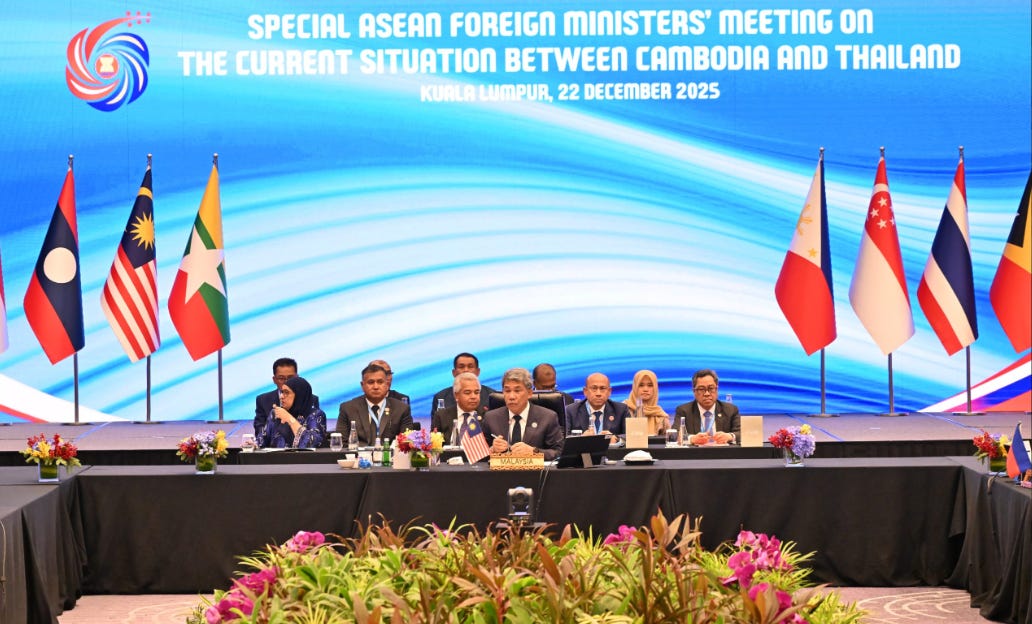
“Border disputes tend to dominate national headlines, but peace is ultimately lived at the local level,” argues one of two national perspectives published by the National University of Singapore on Cambodia-Thailand border tensions. The pieces include a range of recommendations covering areas such as local border integration, grassroots peacebuilding and cultural exchange (link).
“Efforts by Singapore over the last year bear notice,” argues a new piece published over at The Business Times on Singapore’s initiatives beyond the United States and China in a “minus-two world.” The initiatives include reinforcing ties with major powers like Australia and India as well as with neighbors like Malaysia as evidenced by the Johor-Singapore Special Economic Zone (JS-SEZ) (link).


New 2026 Meets Reveal Big ASEAN Major Power Digital Stakes
What’s Behind It
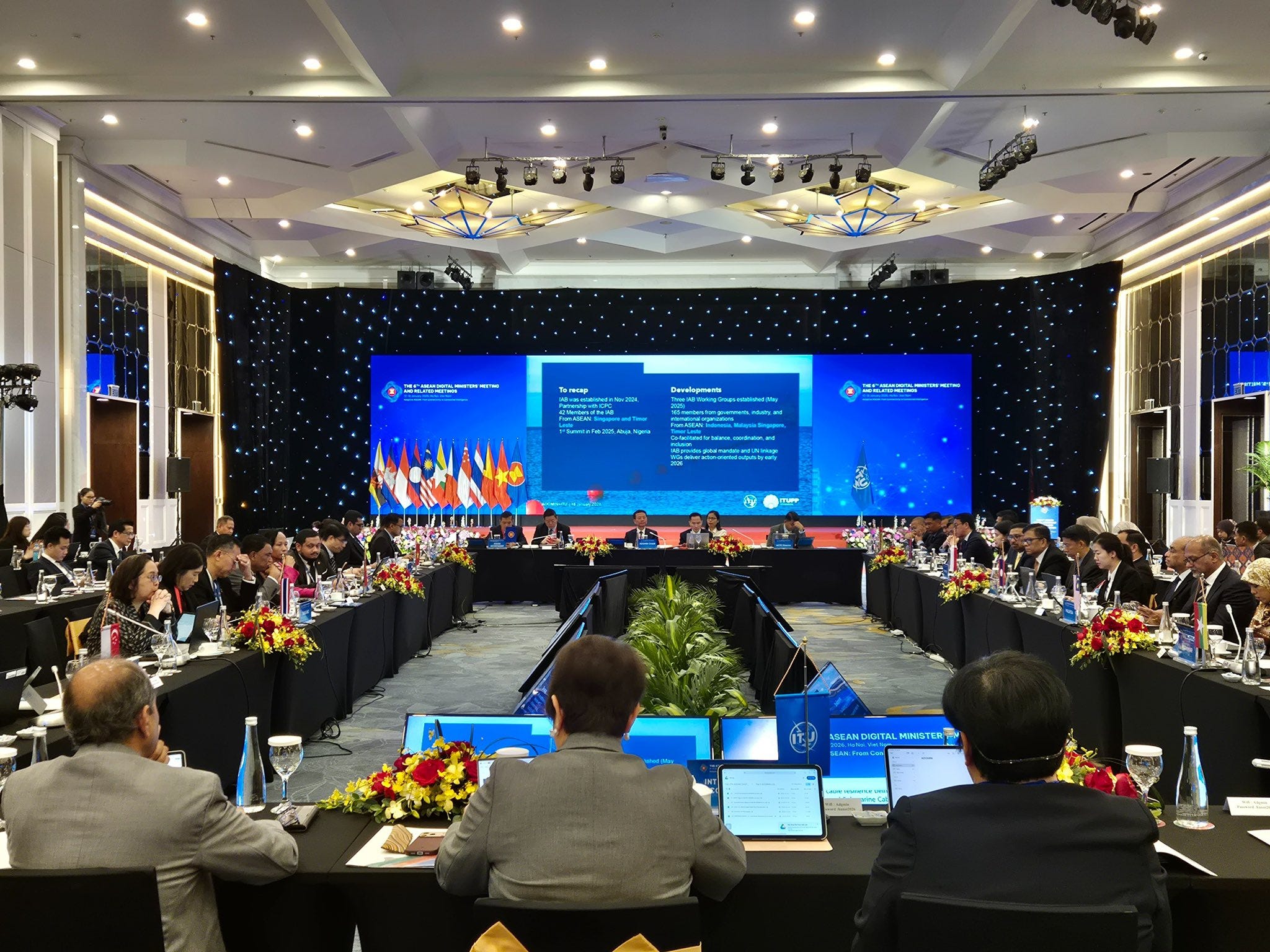
New 2026 meets this past week revealed big stakes at play between key powers and Southeast Asia, including China and the United States1. China’s representative at the meetings captured the contours of geoeconomic tensions underlying consultations in Hanoi as Beijing highlighted new initiatives for 2026 by noting the need for all players to focus on building “open and mutually beneficial” ecosystems2. Ongoing regional and global developments also showcased the cross-sectoral and cross-continental nature of digital developments, including inroads on expansion of the Digital Economy Partnership Agreement (DEPA) which includes Singapore (with Thailand among those expressing interest to join) as well as ASEAN chair President Ferdinand Marcos Jr’s consultations around a “future-ready world” during a Middle East Forum3.
Select Key Related and Recent Geoeconomic Developments Amid Latest ASEAN Digital Meets
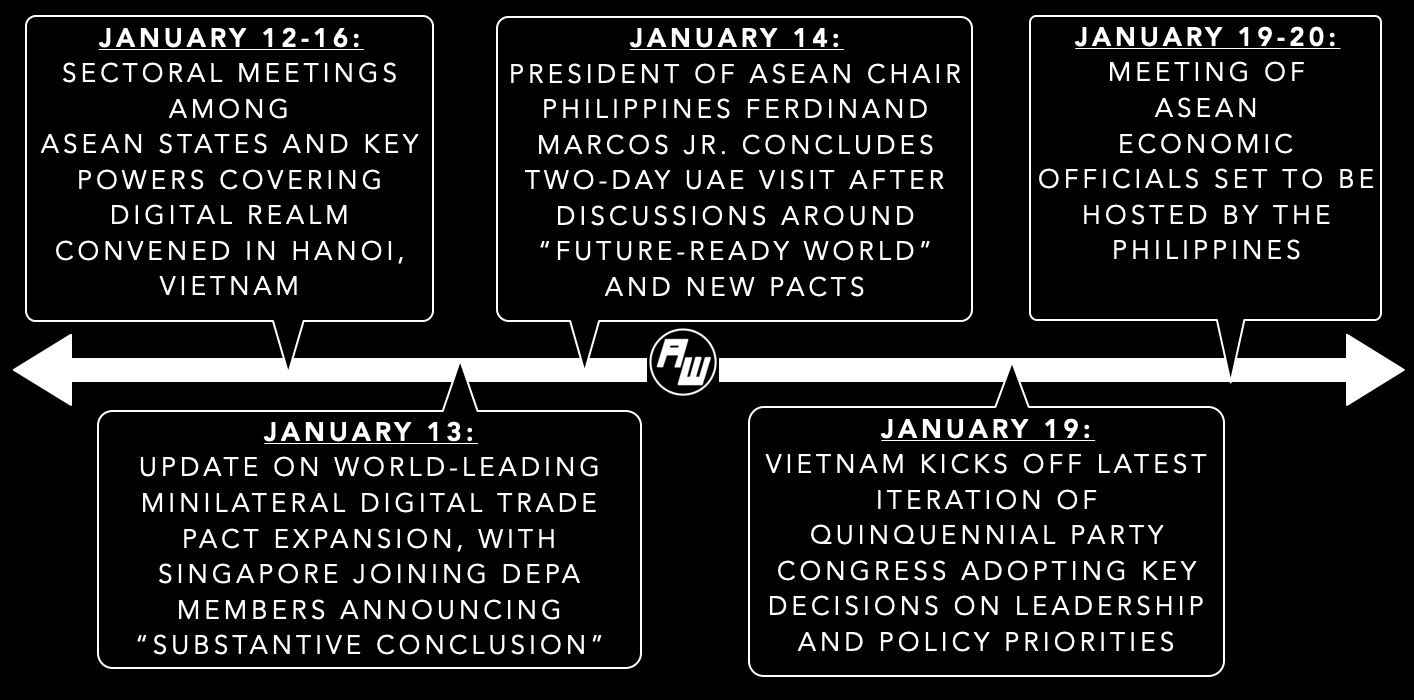
The consultations spotlighted the increasing pressure being placed on ASEAN’s evolving digital agenda with key partners amid the quest for growth in an environment of rising geoeconomic competition. As one official put it in a recent background briefing on Philippine ASEAN chairmanship priorities for 2026, it is no coincidence the “wide lens” being taken on sectoral areas within Manila’s priority economic deliverables or PEDs dovetails with both regional priorities as well as how it is positioning itself as a key market for investment, including through a new artificial intelligence summit and a focus on semiconductor supply chains4. In remarks at the recent regional meets, the ASEAN Secretary General himself mentioned some delayed items within the list of upcoming deliverables that lie ahead for the end of 2026 and then into 2027 and out to 20305.
Why It Matters
The dynamics also spotlighted datapoints to watch with wider implications (see originally generated ASEAN Wonk table below on notable areas to monitor and additional specifics. Paying subscribers can read on for more on what to expect and future implications in the rest of the “Why It Matters” and “Where It’s Headed” sections, along with paid-only sections of the newsletter as usual).
Notable Datapoints to Watch, Along With Key Powers and Major Cooperation Areas
