

A former diplomat and policy advisor argue in a new co-authored book that China is leveraging its growing role as a “rule maker” with Global South countries to power transformational changes in the global geoeconomic order.
WonkCount: 1,293 words (~6 minutes)

Review: China Rule Making in the Global Geoeconomic Order

Context
Speaking earlier this month at the ASEAN Future Forum in Vietnam, China’s ambassador to ASEAN Wang Qing unsurprisingly played up the future promise of the U.S.-China formula of “constructive strategic stability” for the region and the wider world, while also making clear Beijing’s own global initiatives across economic and governance areas1. His remarks and later responses to audience questions — including references to lessons learned from his past posting in Sierra Leone — highlighted how China’s diplomats and officials are seeking to shape narratives around Beijing’s regional and global contributions in a shifting geopolitical and geoeconomic context2.
Select Key Recent Global and Indo-Pacific Geopolitical and Geoeconomic Developments
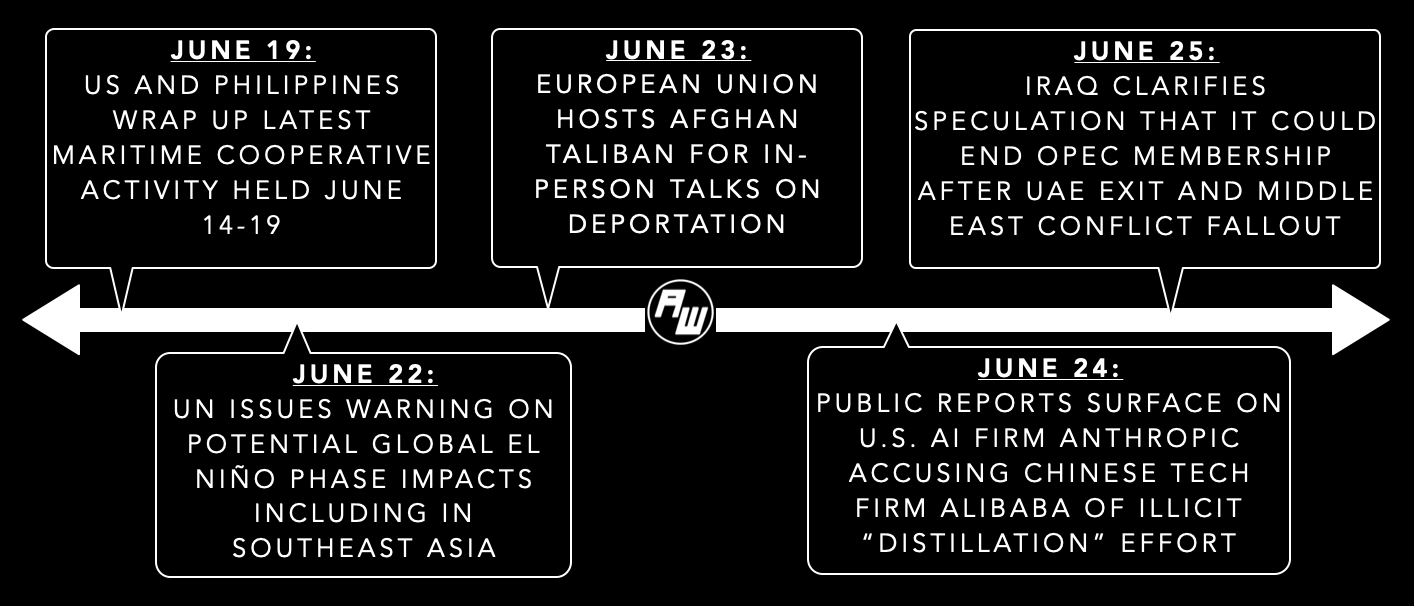
A new book China and the Global Economic Order by scholars Gregory T. Chin and Kevin P. Gallagher sheds light on Beijing’s growing role as a rule maker within the global geoeconomic order3. In doing so, it adds to recent book-length works focusing on China’s evolving approach to regional and global institutions, including ones we have reviewed recently on ASEAN Wonk. China and the Global Economic Order — co-authored by a former diplomat and a policy advisor — argues that a focus on individual China-led proposals or dueling U.S.-China initiatives obscures the broader reality that Beijing is actively working with countries in the Global South both within and beyond existing structures to fuel momentum for consequential institutional changes4. “Through their hybrid efforts, China and other Southern nations are gradually bringing about transformational changes in the global economic order,” the book argues before elaborating on what these changes are and how they may evolve in the coming years5.
Analysis
The book also highlights key future implications to watch (see originally-generated ASEAN Wonk table below for a summary of important contours. Paying subscribers can also read the rest of the “Analysis” section and “Implications” section looking at how these dynamics play out in the future).
Future Implications to Watch, Along With Select Policy Manifestations And Major Global Roles
